

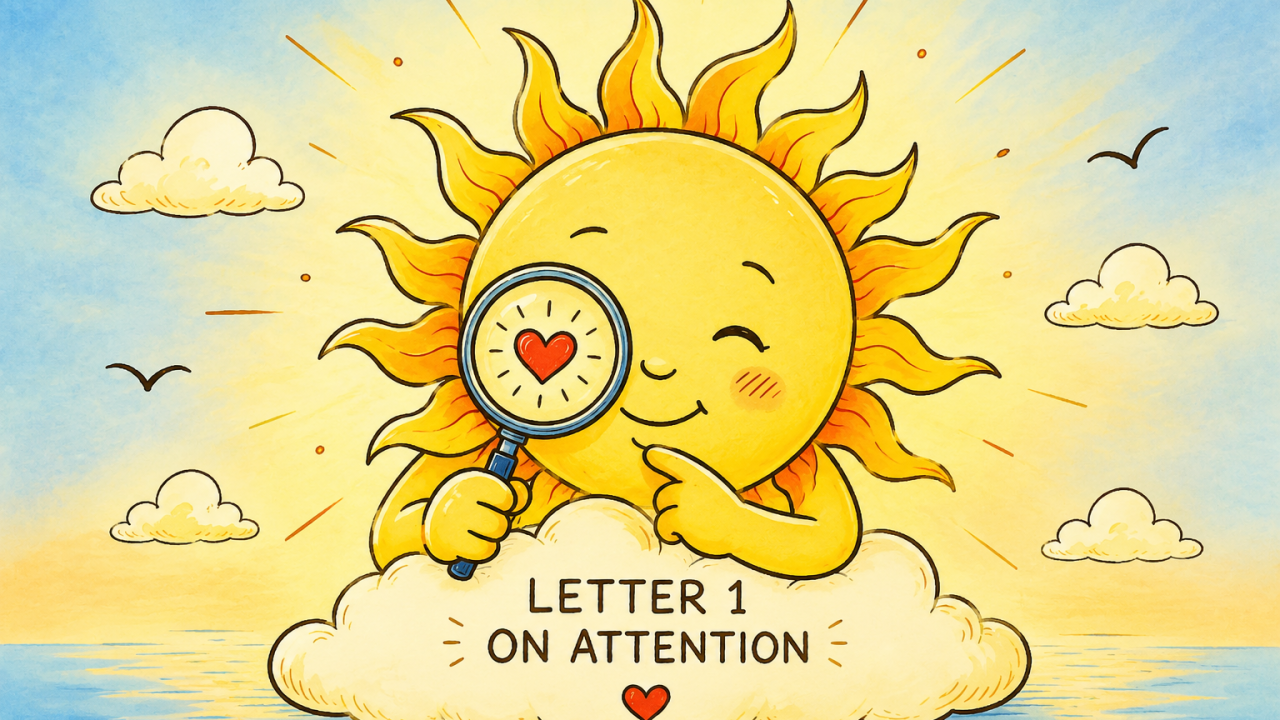
Letter from the Sun to Human Beings – On Attention
Letter 1 – On Attention
Dear Children of the Blue Planet,
I have been watching you for a very long time. And lately, something troubles me.
Your wars, of course, they break my burning heart. But I am referring to something else. You are disappearing. Not your bodies, no no no. Your presence.
I watch you walk through forests without seeing them. I watch you sit at tables with the people you love most, and be somewhere else entirely. I watch you hold your children’s hands while your thoughts are trapped in office rooms, unfinished conversations, imagined futures. I watch you move through luminous moments— a sunset, a first word, a night sky — and miss them. Not because you are not there. But because your attention is not.
And I want to ask you, gently, as an elder who has lived long enough to know: where have you gone?
I have lit your world for five billion years. I have watched every civilisation rise, fall, begin again, and ask the same great questions: how do we live well? what makes a life meaningful? what is freedom? what is love? what is worth giving our brief and precious lives to?
Your sages, poets, philosophers, mystics — always arrived at the same answer, dressed in different languages. Freedom begins with attention.
You tend to think of freedom as expansive, outward-facing, about options and possibilities. But the first act of freedom is simply noticing. Noticing your impulses before you follow them, noticing the assumptions baked into a situation, noticing when you are on autopilot. Noticing when your attention has been pulled, captured, colonised — by algorithms, anxiety, habit, worry, or other people’s urgency. A life shaped by unchosen attention is still a shaped life, just not your own.
Epictetus, who owned nothing but possessed the sovereignty of his inner life, taught that the one thing no one can take from you is the faculty of choice — the power to decide where your mind rests. The power to choose how you meet what happens. Marcus Aurelius, who carried the weight of an empire, practiced humility daily, and spent his private hours learning to return his wandering attention, again and again, to what was true and good. William James, listening carefully to the movements of consciousness, saw that the voluntary return of a wandering attention lies at the root of judgment, character, and will.
They were all describing the same thing. The person who chooses where to place their attention chooses the shape of their life.
Here is what I have learned, from my long vantage above the turning world.
Attention is not passive. It is not about merely observing life. It is about creating it. Watch the chain carefully:
Where you place your attention shapes what you perceive. What you perceive stirs what you feel. What you feel guides what you decide. What you decide, repeated across days and years, becomes the path you walk. And the path you walk becomes your life.
The entire architecture of a human existence rests on that first, quiet, largely invisible choice: what do I give my gaze to?
But I watch what is being done to your attention now, and I want to speak plainly.
There are forces in your world — clever, relentless, extraordinarily well-resourced — whose entire purpose is to fragment and capture it. To slice your gaze into pieces too small to sustain a thought. To keep you skimming the surface of everything and the depth of nothing. To monetise your distraction. To profit from your absence.
They know what you have forgotten: that your attention is the most valuable thing you carry.
A scattered mind cannot love well. It cannot think clearly. It cannot choose freely. It can only react — pulled from stimulus to stimulus, from craving to craving, never arriving anywhere, and never truly inhabiting its own life. This is not freedom. It is a very well-designed cage.
Tell me, dear children: when was the last time you listened to your own heartbeat and felt deeply grateful for it? When was the last time you entered a state of flow? That amazing feeling when you enter so completely into something — music, work, prayer, conversation, beauty, silence — that time loosens its grip? Those moments where the restless self disappears. When you are fully present, experiencing reality as it is. Or rather, becoming one with it. These moments are not reserved for artists, elite athletes, or a gifted few. They are for all of you.
The magic of life lives in the here and now. And yet the here and now is precisely what you keep abandoning.
Think of attention as one of the deepest forms of love, and one of the foundations of a meaningful life. Of course, I do not mean attention merely as concentration in a technical sense. I mean presence. A way of truly inhabiting life.
Thich Nhat Hanh believed that the most precious gift we can offer others is our presence. And presence begins with attention. Simone Weil called attention the rarest and purest form of love. To truly attend to something, to a person, to a moment, to a question, is to give it the most precious thing you possess. Yourself. Your presence. Your full and unhurried gaze.
My dear children, most of your suffering comes from living mechanically — lost in regrets about the past, anxieties about the future, or constant distraction. Lost in the endless noise that prevents you from meeting the only place where life can ever truly touch you: this moment. This breath. This face. This patch of sky.
Attention brings you back to the miracle of the present moment.
I understand the longing to numb yourselves in Netflix series after an exhausting day. You carry much, but constant stimulation prevents you from encountering your true selves. Silence, mindful breathing, contemplation, and meditation bring you back to your essence. They are not escapes from life, but ways of returning to it more fully.
Think about it for a second, all your ancient wisdom traditions knew this. The Vedic sages. The Buddhists. The Taoists. The Sufis. The Christian mystics. The Indigenous elders. The lovers of wisdom from every age. They knew that a life without inner silence becomes vulnerable to every outer noise.
Across your beautiful blue planet, long before your screens began to glow in your hands, human beings sat in silence, watched the breath, prayed, chanted, walked slowly, fasted, listened, contemplated, bowed, sang, entered forests, climbed mountains, lit candles. They turned inward — not to flee the world, but to meet it with a clearer mind and a more compassionate heart.
So here is what I ask of you, dear children.
Guard your attention as you would guard gold — no, guard it better than gold, because gold you can recover and attention you cannot. Each moment it is stolen, it is gone.
Build for it small sanctuaries. Pockets of silence in your days. Mornings before the screens. Walks without the voice in your ear. Meals where you taste what you are eating and look at the faces across the table. Moments of sky. Of nature. Of poetry. Of silence, contemplation, and meditation.
And when your attention wanders — and it will, for you are human and the world is loud — do not be harsh with yourself. Simply return. This returning, again and again, with patience and without judgment, is the practice. It is, in fact, the whole practice. Come back. Come back. Come back.
The good news is discipline is built through practice. The muscle of attention is built exactly this way — not in one great act of will, but in ten thousand gentle returns.
Believe me, that presence behind the noise — is where your freedom lives.
Protect it. Tend to it. Let nothing colonise it without your consent.
Because the life you are living is not a rehearsal. There is no later version where you will finally be present. There is only now — this light, this breath, this person in front of you, this unrepeatable moment already becoming the past.
I have shone over five billion years of unrepeatable moments.
Trust me when I tell you: they are worth attending to.
With ancient and luminous love,
— The Sun ☀️
Paule Ansoleaga Abascal
pauleansoleagaabascal@gmail.com


