

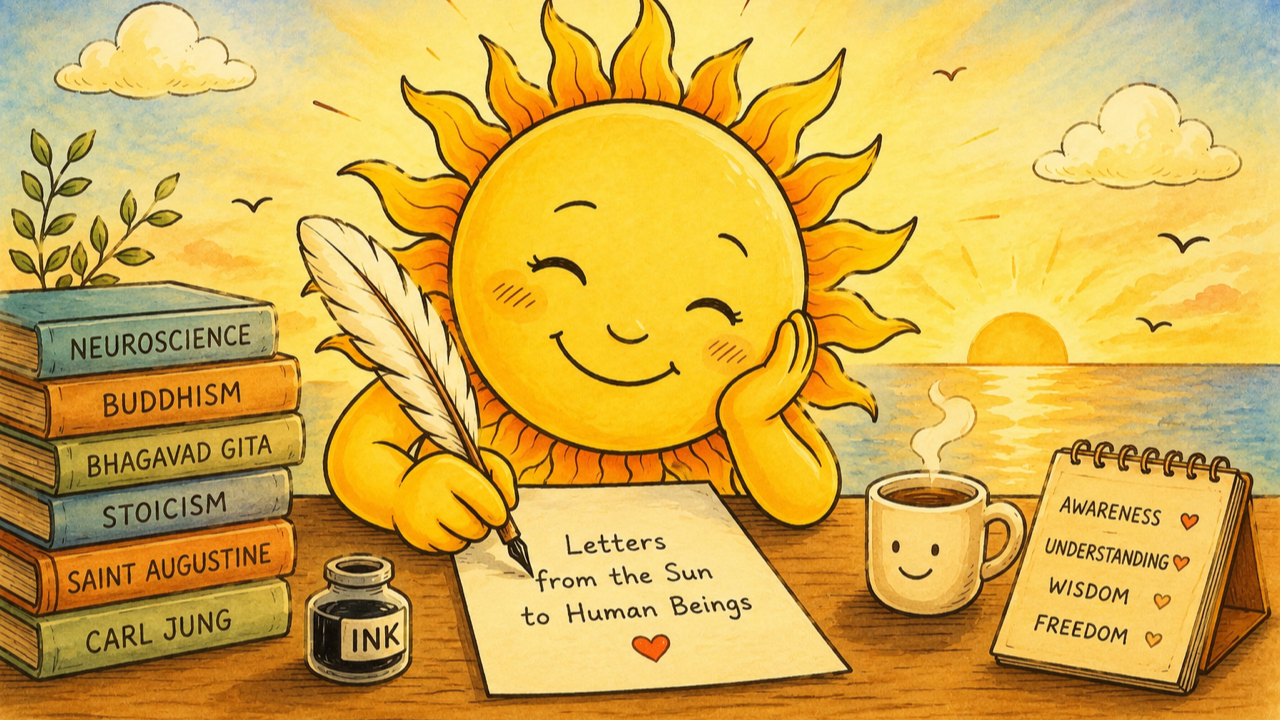
Letter from the Sun to Human Beings – On Desire
On Desire
My dear children of the blue planet,
Come and sit with me for a little while. There is something I would love to share with you.
I have watched your mornings for longer than your history remembers. I have seen your first cries, your first embraces, your first dreams. There is a force that has accompanied you through every age, every civilisation, every love story, and every invention. I have watched it shape your greatest triumphs and your deepest sorrows. It has built temples and empires, written symphonies and poems, crossed oceans and reached for the stars. It has also broken hearts, started wars, and left countless souls forever chasing a horizon that kept moving away.
You have given this force many names. Today, let us call it desire.
I have watched you desire for as long as you have existed. Before you had words for it, before you had gods to pray to or poems to give voice to the ache in your chest, you desired. I was there when one of your distant ancestors first lifted their eyes towards the horizon and felt something calling from beyond it. I have been watching that mysterious pull ever since.
And I have watched something else. I have watched you confuse desire with its shadow. Desire is the energy that draws you towards life. The force that inspires an artist to paint, a scientist to discover, two lovers to meet, a pilgrim to seek truth.
Its shadow is something different. The Tibetan masters called it dö chag: sticky desire. The kind that grips, clings, and whispers, “Only this… then I will finally be happy.” It tries to fill an inner emptiness with an outer circumstance and refuses to loosen its grip. Desire is the river. Attachment is the attempt to hold the river in your hands.
I have watched this pattern unfold in every century, in every civilisation. It begins with attention. Your mind rests upon something: a person, an object, an experience, a future version of yourself. The longer it remains there, the more strength it gathers. Attention becomes longing. Longing becomes wanting. Wanting becomes needing.
And then your brain, that tireless prediction machine, begins rehearsing the future before it arrives. It imagines the promotion, the house, the relationship, the recognition. It creates a story around it. By the time reality appears, it must compete with a version already perfected inside your imagination. And the gap between what is real and what was imagined gives rise to disillusion, disappointment and frustration.
Other times you receive exactly what you wanted and, for a while, it is enough. The house, the partner, the position—they fill you just as you hoped they would. But then, without you noticing the moment it happened, they become ordinary again. What once felt extraordinary becomes the new baseline. And the mind, built more for seeking than for resting, has already lifted its gaze towards the next horizon.
Today you call it hedonic adaptation, the never-ending treadmill. Whatever the name, a life governed by endless craving can never know peace. The more you seek fulfilment in “more,” the more restless your mind becomes. Freedom begins not when desire disappears, but when you are no longer enslaved by it.
Saint Augustine of Hippo experienced this himself before his conversion. He searched for happiness where many of you still search today: in knowledge, success, recognition and pleasure. He became one of the finest minds of his generation and built the distinguished career he had long desired. From the outside, he appeared to have every reason to be happy. Yet inwardly he remained profoundly restless. Looking back in his Confessions, he realised that he had been asking finite things to satisfy an infinite longing. He had been looking for happiness in the wrong places.
I watched generations of poets and philosophers shape the Bhagavad Gita. As they contemplated the deepest questions a human being can ask, they arrived at a simple truth: desire is not the problem. Attachment is.
Attachment is the invisible bond the mind forms with an imagined outcome. It arises the moment desire ceases to be a movement towards life and becomes a condition for happiness. It whispers, I need this to be happy. Every desire carries a promise. The question is whether it can keep it.
Buddhist teachers explain this with extraordinary tenderness. Non-attachment has never asked you to stop wanting, or to stop caring. It asks only that you notice the moment when a preference becomes a demand, when a hope becomes a condition for your happiness. Preference bends when life changes. Attachment resists reality and experiences every change as a personal defeat.
But do not mistake non-attachment for indifference. Remember the ancient battlefield where Arjuna stood paralysed between duty and grief. Krishna told him to care so deeply that he could give himself completely to the action while releasing his grip on the result. You have the right to perform your actions, but not to the fruits of your actions. Act with your whole heart, and let the outcome go. In that moment, your happiness belongs to you again instead of to fortune.
Centuries later, the Stoics unveiled another face of the same truth. They realised that no one becomes free by chasing what fortune can remove. Wealth can disappear. Health can weaken. Reputation can change with the opinion of a crowd. Even those you love most cannot remain with you forever. But your judgements, your choices and your character are yours to cultivate each day.
Like the Gita, the Stoics never asked you to become desireless. No human being could. Instead, they invited you to educate your desires. Desire excellence rather than success. Desire wisdom rather than admiration. Desire integrity rather than applause. Success may or may not follow excellence, admiration may or may not follow wisdom, applause may or may not follow integrity. But excellence, wisdom and integrity always remain within your reach.
Saint Augustine of Hippo discovered another profound truth. Your heart always moves towards what it considers most valuable. Echoing Jesus’ words, “For where your treasure is, there your heart will be also,” he realised that your deepest loves shape your entire life.
If your treasure is status, your peace gradually becomes dependent on recognition. If your treasure is wealth, your worth rises and falls with circumstances. If your treasure is beauty, your identity becomes increasingly fragile with time. Whatever you place at the centre of your life acquires the power to govern your heart.
Augustine called this the ordo amoris, the order of loves. He believed that suffering does not arise because you love the wrong things, but because you love good things in the wrong order. Wealth, success, beauty, friendship, family and achievement are all genuine goods. They become burdens only when we ask them to occupy the place that belongs to something greater. For Augustine, that highest good was God—not simply a religious idea, but the very source of Truth, Goodness and Love. Only what cannot be lost can become a lasting foundation for happiness. Everything else is beautiful, but temporary.
My dear children, I know this is not easy. I have watched you struggle with it since the beginning.
So what can you do to step off the treadmill? Understand your desire rather than trying to silence it. As always, the solution begins with awareness. Before your mind carries you away, before wanting becomes needing, observe its movement. Buddhist monks cultivated mindfulness; the Stoics practised prosoche. Different names, different cultures, the same human discovery. Freedom begins with awareness. And awareness begins with a pause. With silence. For when silence comes, your mind grows quiet, and you can finally hear your heart. In that stillness, you create a space between the arising of a desire and your automatic reaction to it.
Then a different question becomes possible. Instead of asking, What do I want?, you can ask, Why do I want it? Do I seek the new position because it allows my gifts to flourish in the service of others, or because I hope recognition will finally convince me that I am enough? Do I long for a relationship because love is ready to overflow from my heart, or because I hope another person will silence my loneliness? Do I really need this new possession, or do I long for the feeling I imagine it will bring? Am I reaching for an outer solution to an inner discomfort?
These questions do not eliminate desire; they illuminate it. Awareness is the light that reveals attachment and, often, the hidden longing beneath it. Once attachment is seen clearly, your hands stop trying to hold the river. They remain open, and life continues to flow through them. The longing may still be there, and I would never wish to take it away from you. Longing is part of what makes you beautifully human. But it moves through you differently. Freely. Desire is no longer something that controls you; it becomes something you understand.
Remember Carl Jung’s insight: until we bring the unconscious into the light of awareness, it continues to shape our lives from behind the scenes. A famous phrase often attributed to him captures this beautifully: “Until you make the unconscious conscious, it will direct your life and you will call it fate.” Many of the desires that move us are not ends in themselves, but expressions of deeper, unconscious longings. Not every desire reveals what your heart truly seeks. Sometimes it only reveals what it believes it lacks.
There is one final shift I have watched transform countless lives. The most important one. It begins when the question changes from What can I get? to What can I offer? Getting asks the world to complete you. Giving allows your fullness to overflow into the world. I have rarely watched someone give with the face of sacrifice. Genuine giving almost always wears the face of joy.
That is why giving escapes the endless cycle of adaptation. A bigger house eventually becomes your ordinary house. A promotion eventually becomes your ordinary job. But a life devoted to love, purpose and service rarely becomes ordinary, because it was never chasing a personal peak in the first place. A desire greater than the self is the one desire I have never watched fade.
You have been reaching since the beginning, and I have loved watching you reach. Do not fear your desires. Listen to them. Understand them. Educate them. As Saint Augustine reminded you, cultivate the ordo amoris, and the rest of your life will slowly begin to find its own order.
I have never watched a human being become free by getting everything they wanted. I have watched many become free by discovering what their heart was truly longing for. Once they saw it clearly, their desires slowly found a new order. They stopped chasing what merely glittered and began walking towards what gave their lives meaning. From meaning came purpose. From purpose came freedom, inner peace and lasting joy.
They discovered that happiness had never been waiting at the end of desire. It had been growing within them every time they chose what was lasting over what was fleeting, what they could give over what they could get.
Keep desiring, my dear children. Just learn to desire wisely.
I will always be here, rising every morning, reminding you that you, too, were made to shine.
With endless tenderness,
— The Sun ☀️

Paule Ansoleaga Abascal
pauleansoleagaabascal@gmail.com


