

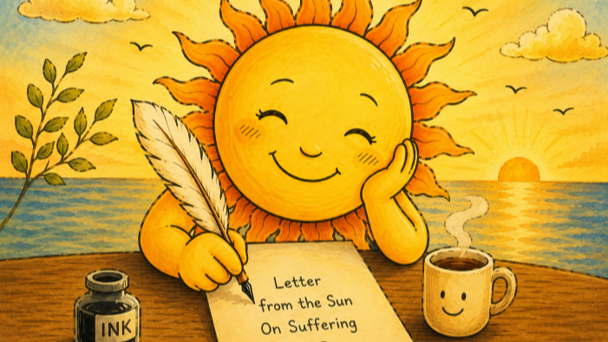
Letter from the Sun to Human Beings – On Suffering
My dear children of the blue planet,
Come and sit with me for a little while.
Every time I watch one of you suffer, I wish I could wrap you in my light and hold you close. Since I cannot, I hope these words may offer a little of the warmth I wish I could give you.
Pain belongs to life. Poverty, war, illness, failure, grief, loneliness, none of these ask your permission before they arrive. I wish it were otherwise.
Some pain is real, unavoidable and undeserved. I would never ask you to pretend it is not.
But over the millennia I have watched you turn pain into suffering through the stories you tell yourselves about the past and the fears you create about the future. Let me show you what I mean.
Your partner leaves you. That is painful. But then your mind adds another layer: I am not worthy of love. Nobody will ever love me again. I will never find the right person. That is suffering your mind has added to the pain.
You lose your job. That is painful. But then your mind begins again: My life is over. I am not good enough. I have failed. What will people think of me? None of these thoughts changes what has happened. They simply drain the strength you need to begin again.
Seneca once observed that we suffer more often in imagination than in reality. I have watched this for thousands of years, and I would add: you suffer in memory as well as in imagination. You carry regret about yesterday, anxiety about tomorrow, resentment towards the past, and worry about the future. None of it is happening in this moment, yet the suffering it creates can feel every bit as real.
“We suffer more often in imagination than in reality.” — Seneca
Sometimes you remain in suffering, not because you wish to suffer, but because suffering has become familiar. Like so many of life’s difficult choices, leaving what no longer serves you can feel more frightening than staying with the pain you already know. Healing invites you to become someone you have not yet met.
My dear children, pain belongs to life. Suffering is often the story your mind builds around pain: comparison, resentment, self-pity, and the belief that life should have unfolded differently. The Buddha explained this through the image of two arrows.
The first arrow is the pain that life sometimes sends your way. You cannot avoid it. It may be the death of someone you love, an illness, a broken heart, or losing your job. Or it may be a smaller arrow: a careless remark, a disappointment, a misunderstanding.
The second arrow is the one your own mind fires afterwards: resisting the pain, replaying the past, comparing your path with someone else’s, imagining how life should have unfolded, or worrying about all the possible catastrophic futures.
The first arrow hurts. The second is the one you can learn not to fire.
Pain needs to be felt. Suffering wants to be fed. You can choose which one you answer.
Pain comes and goes like the seasons. It arrives uninvited and can turn your world upside down. Whether it comes from a devastating loss or from one of life’s countless small disappointments, my invitation is the same: feel it fully, without turning it into your identity.
If you allow yourself to grieve, to cry, to mourn what has been lost, the pain gradually begins to soften. Your heart learns to make room for it. If you remain open to what pain may have to teach you, instead of resisting it, it has the power to make you wiser, more compassionate, and more grateful for what has been and for what remains.
Suffering is different. It can linger for years. Every time you replay the story, resist what has happened, or insist that life should have unfolded differently, you breathe new life into it.
I have watched many of you spend years trying to outrun pain, suppress it, or pretend it is not there. But pain does not disappear because you refuse to feel it. The more fiercely you resist it, the more tightly suffering wraps itself around you.
Please do not blame yourselves for this. Your minds were never designed to make you happy. They were designed to keep you alive.
For hundreds of thousands of years, survival depended on noticing danger before beauty, threats before opportunities. Those who paid closest attention to what could go wrong were more likely to survive and become your ancestors. That ancient inheritance still lives within you.
Your mind remembers criticism more easily than kindness. It rehearses tomorrow’s worries more often than yesterday’s joys. It imagines all the ways things might fall apart before it imagines how they might come together. It returns, again and again, to the moments that embarrassed you, the mistakes you wish you had never made, the conversations you wish you could relive.
Today, this ancient survival system encounters a world it was not designed for.
You open your phone and, within seconds, you are comparing your life with hundreds of carefully edited lives. Someone younger succeeds faster. Another person appears happier. Wealthier. More beautiful. More loved. And suddenly, without anything around you having changed, your life begins to feel poorer.
Comparison is one of the greatest sources of suffering I have ever watched. It convinces you that your path should have looked like someone else’s. But you are comparing your entire journey with a single moment in theirs. You see only one photograph, not the entire video.
The Buddha understood this well. He knew that a mind disturbed by comparison cannot see clearly, just as the wind disturbs the surface of a still lake. When the water is restless, it can no longer reflect the sky. When resentment, comparison and resistance fill your attention, life’s blessings become invisible. The blossom of a flower. Your children’s smile. You no longer notice them.
Without even realising, your gaze turns away from growth and towards grievance. Instead of asking, What can I learn from this? How can I grow through this? or What is life asking of me now? you begin asking, Why is this happening to me? Why am I behind? Why does everyone else seem to have it easier?
The first questions lead towards wisdom. The second towards bitterness, resentment, anger or victimhood. Life will wound you sometimes. Resistance keeps the wound open.
Fortunately, my dear children, I have great news. Both ancient wisdom and modern neuroscience point to the same profound truth: while you cannot always choose which thoughts arise, you can choose which ones you nurture and allow to take root within you. Through mindfulness, contemplation, or simply pausing before you react, you begin to discover that you are not your thoughts. You are the one who notices them. And each time you choose awareness over habit, your mind learns a new way of responding. In that awareness lies your freedom.
From that freedom comes another extraordinary gift: the power to choose what your pain, your losses, your setbacks and your failures will come to mean. The capacity to find purpose in adversity.
Think of Viktor Frankl, who endured one of the darkest chapters of your history. Surrounded by cruelty, hunger and death, he discovered that there was one freedom no prison could take away: the freedom to choose his attitude towards what life had placed before him.
He later reflected that, among those who endured the concentration camps, it was often not the physically strongest, nor the fittest, who found the strength to keep going. More often, it was those who had managed to preserve a reason to live. Some longed to return to the people they loved. Others still had work they felt called to complete.
From this experience came one of his most enduring insights: “Those who have a why can bear almost any how.”
In that same darkness, not far from where Frankl was later imprisoned, I watched a young woman named Etty Hillesum keep a diary by lamplight as she waited for a train that would carry her towards her death. She did not look away from what was happening to her. She named the hunger, the fear and the daily cruelty. But she made herself a promise: she would not let hatred take root in her, however much the world around her seemed to deserve it. She wanted to become a steady, thinking presence inside the barracks, a person who kept noticing beauty even there: a single flower, a patch of sky beyond the barbed wire, the kindness of another human being sharing the same suffering. She did not survive. But the pages she left behind continue to inspire millions to refuse to let hatred have the final word, to refuse to fire the second arrow, even when the first has struck with all its force.
My dear children, I do not wish to romanticise suffering. Some wounds are simply wounds. There are moments when the only appropriate response is grief.
And yet I have watched human beings create meaning where none seemed possible.
A rejection became the courage to begin again. A failure became wisdom. A loss became the reason someone dedicated their life to helping others carry theirs. Think of Nelson Mandela, who transformed twenty-seven years in a prison cell into a nation’s reconciliation. Or Malala Yousafzai, who transformed a bullet into a voice for every girl denied an education. When pain finds purpose, it becomes an incredible source of transformation.
Rumi said it beautifully: “The wound is the place where the Light enters you.”
My dear children, it is perfectly okay not to be okay sometimes. There are no shortcuts through grief. Allow your tears to come when they need to. They belong to life.
But while you cannot always choose what happens to you, you can choose which thoughts you allow to take root within you. Let go of those that tell you that you are powerless, broken, or forever defined by what happened. Hold on to those that remind you of your courage, your resilience, and your extraordinary capacity to begin again.
Instead of asking, Why is this happening to me? you can always ask, What can I learn from this? How can I grow? What is life asking of me now?
Talk to yourselves as you would speak to someone you love. Be patient with your healing and gentle with your mistakes. Trust the process, even when you cannot yet see where it is leading. And please, do not measure your life by outcomes, nor by the success of others. Measure it by the peace in your heart, by whether you are becoming wiser, kinder and more courageous than you were yesterday.
You are not the worst thing that has happened to you. You are the meaning you choose to create from it. And that meaning may one day become a light for someone else.
Keep walking, my dear children. Even on the days when you can only take one small step.
I will always be here, rising every morning, reminding you that even the longest night has never stopped the dawn from coming.
With endless tenderness,
— The Sun ☀️

Paule Ansoleaga Abascal
pauleansoleagaabascal@gmail.com


