

Plato’s Cave and the Shadows We Still See
From the values we inherit to the freedom we can find, and the legacy we can leave
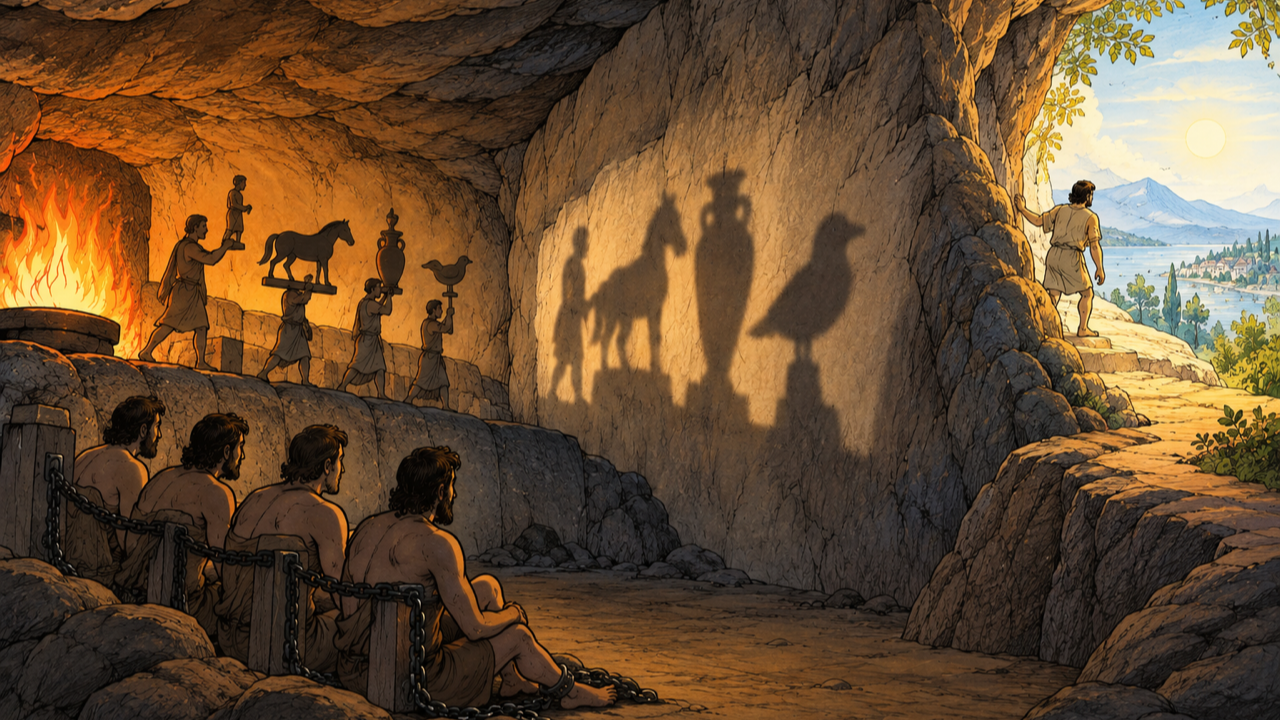
In Plato’s Allegory of the Cave, prisoners have spent their entire lives chained inside a dark cavern, facing a wall. Behind them burns a fire, and between the fire and the prisoners people carry different objects, casting shadows onto the wall in front of them. Because the prisoners have never seen anything else, they mistake the shadows for reality. They have never seen the fire, let alone the Sun outside. They cannot even imagine that an entirely different world exists out there.
More than two thousand years later, I wonder whether we have ever left Plato’s cave. The cave itself might have changed, its shadows might be more sophisticated, but we are still looking in the wrong direction. Towards outer achievement, towards a narrow idea of success, towards an economic model that is exceeding planetary boundaries.
Somewhere along the way, we seem to have built a remarkably narrow understanding of what it means to live well. Progress became associated with growth, success with achievement, and happiness with wealth. These ideas have become so deeply embedded in our culture that we rarely stop to question them. They appear to be reality itself.
The shadows on Plato’s wall.
The Shadows I See
To me, today’s shadows are the messages we absorbed before we were old enough to question them. Have more. Do more. We heard them from our families, schools, workplaces, advertising and the culture around us until they stopped sounding like instructions and started sounding like truth.
Some are obvious: advertising telling us what we need; social media showing edited versions of other people’s happiness, beauty and success; political messaging reducing complex realities to slogans; algorithms deciding which fragments of the world reach our attention.
But I think the more interesting modern shadows are the assumptions underneath those images.
One is the belief that success can be measured through external achievement: income, qualifications, professional recognition, followers, possessions. Another is consumerism: the idea that fulfilment is waiting in the next acquisition, experience or upgrade. The new house, the better body, the more exotic holiday. Desire continually projects an image onto the wall saying: when you obtain this, you will finally be satisfied. Of course, shortly after obtaining it, another shadow appears.
A particularly powerful contemporary shadow is comparison. For most of human history, we compared ourselves with those around us. Today we can compare our ordinary Tuesday morning with the most beautiful moments selected from millions of other lives. We know intellectually that these are curated images but still respond emotionally as though they represented reality.
There is also the shadow of constant productivity: the assumption that time must always be useful, that doing nothing is wasteful, that being busy signifies importance, that our value depends upon how much we produce.
And then there are deeper shadows.
One is the belief that economic growth and human progress are the same thing. GDP gives us important information about economic activity, but it does not tell us whether people are flourishing, whether communities are cohesive, whether ecosystems are healthy, or whether a society has become wiser.
Another is the idea that human beings are separate individuals, competing for their own share of the world. Biology, ecology and ordinary human experience reveal extraordinary levels of interdependence, yet many of our institutions and cultural narratives encourage us to imagine ourselves as autonomous, independent, self-sufficient individuals.
Even our relationship with nature carries shadows: seeing nature as something “out there” (scenery to visit, resources to extract, an environment surrounding humanity) rather than recognising ourselves as living beings embedded within and dependent upon her.
I am not saying these shadows are false. A salary matters. Economic growth matters. Technology can improve lives enormously. To me, the philosophical problem begins when we inherit a partial view of reality, fail to question it, and mistake it for the whole. When these shadows shape our values and influence our worldview without us even realising it. When we live what Socrates called an “unexamined life”: a life lived without questioning what we believe, what we desire, why we act as we do, and what we consider good or worthwhile.
Why does this matter so much to me? Because our values and worldviews shape the world we build and leave to future generations. They influence which businesses grow (education or weapons), which ideas receive capital (renewable energy or new drilling projects), which infrastructure is built (hospitals or new warplanes). Recognising the shadows and stepping out of Plato’s cave is therefore not only about how we live our own lives. It is also about the kind of society we help create.
How the Shadows Were Made
The shadows we see today did not appear overnight. We created them, collectively, over centuries. Our civilisation gradually organised itself around a particular hierarchy of values: growth over flourishing, accumulation over virtue, having over being. But these values are not laws of nature. As Chimamanda Ngozi Adichie once said, “Culture does not make people. People make culture.” And we can change what we have created.
In my book, Philosophy and Finance: A Love Story, I explore the extraordinary journey of economics from the ancient Greek oikonomia (the management of the household, within a much broader reflection on how human beings should live) to today’s increasingly mathematical and specialised economic science. Along the way, economics gradually detached itself from philosophy, and from questions of ethics, virtue and human flourishing.
This transformation went far beyond economics. It altered the way we perceive the world, our values, even our idea of happiness.
The Scientific Revolution transformed human existence, opening possibilities previous generations could hardly have imagined. It also gradually changed the questions we asked of the world. Questions of how increasingly took centre stage. We became extraordinarily good at understanding how the world works while becoming less accustomed to asking why, and what all this progress is ultimately for.
Our conception of the human being changed too, from Aristotle’s zoon politikon, a social and political animal whose flourishing was inseparable from virtue, friendship and community, to homo economicus: the rational, self-interested individual seeking to maximise utility.
Then came the Industrial Revolution. Mass production gave societies the capacity to produce goods on a scale never seen before. As production expanded, consumption had to follow…
By the 20th century, the machinery had become increasingly sophisticated. Advertising began to associate products with identity, beauty, success, belonging and happiness. Yes, happiness. Thrift and restraint gradually gave way to an ethos of acquisition, and economic growth became increasingly dependent on continuously creating new wants. We stopped consuming only to meet our needs, and learned to consume as a way of being.
Yuval Noah Harari captures this transformation brilliantly in Sapiens. He describes capitalism and consumerism as two complementary sides of a new ethic: the rich are encouraged to invest, while the rest of us are encouraged to buy. Traditional ethical and spiritual systems asked something difficult of human beings: to cultivate compassion, overcome craving, restrain selfishness, transform ourselves from within. Too complicated for most mortals. Consumerism asks us to give free rein to desire, keep acquiring, keep consuming, and trust that happiness will eventually follow.
It is a remarkably seductive promise. Happiness, fulfilment, are always waiting ahead of us, one purchase, one achievement, one upgrade away. This is, to a large extent, the world we inherited.
And then came social media. The machinery acquired an extraordinary new amplifier. Comparison became constant, advertising became personal, algorithms learned what captures our attention, and the lives, bodies, homes, careers and experiences of others became permanently visible.
The shadows follow us everywhere.
Stepping Out of the Cave
In Plato’s allegory, liberation begins when one of the prisoners turns around. For the first time, he sees the fire and begins to understand that what he had taken for reality was a collection of shadows. Eventually he leaves the cave. The light initially hurts his eyes, but gradually his vision adjusts, and he begins to see the world as it really is.
We are luckier than Plato’s prisoners. We don’t carry their chains, we can turn around. We can look at the fire behind us and begin to understand how some of the shadows were made. To me, that is precisely what philosophy is for: to turn our gaze towards the exit of the cave, towards the light. The Queen of the Sciences invites us to question the worldviews and assumptions we take for granted, and to examine the desires we obey without question.
Philosophy, the love of wisdom, can serve as a precious inner compass for life.
“But neither do these come within the compass of our mental powers; and it was the duty of philosophy to destroy the illusions which had their origin in misconceptions, whatever darling hopes and valued expectations may be ruined by its explanations.”
Immanuel Kant, Critique of Pure Reason, Preface to the First Edition (1781)
But embracing philosophy as a way of life, as our Greco-Roman ancestors did, requires curiosity, honesty and courage. It is not always comfortable. In Plato’s cave, the light initially hurts the prisoner’s eyes. Something similar can happen when we begin to question ideas we have lived by for years. We may feel misunderstood by those still looking at the wall, who might call us strange, naïve or lost when they see us change.
But if we persevere, a more eudaimonic existence is waiting out there. And I can confirm that, from the bottom of my heart. An existence less dominated by having and doing, with more space for being. For connection with our true selves, with others, with the whole cosmopolis. For inner peace and freedom. True freedom.
Philosophy reminded me that wealth can take many forms. Time. Relationships. Health. The capacity to love. Knowledge. Beauty. The opportunity to make a contribution. Inner peace. It taught me that true wealth is what we leave behind: the love we give, the knowledge we share, the beauty we create.
The good news is that ancient wisdom offers us a clear compass towards the light. The Stoic recipe, for example, was virtue, wisdom, friendship, service, character, gratitude and living according to nature. They did not consider material things inherently bad, and wealth itself was not the problem. What mattered was the place these external things occupied in our lives, and whether our inner wellbeing had become dependent on them.
This distinction matters enormously. Capitalism, entrepreneurship (powered by finance) and wealth creation have generated extraordinary innovation, prosperity and improvements in human life. The challenge is to make sure they serve us, not the other way around. The point is not to stop having, doing or achieving. It is to stop confusing them with being.
The Stoics had another beautiful concept that can help us here: oikeiosis, the gradual expansion of our sense of belonging. Hierocles represented this through his circles of concern: ourselves at the centre, then our family, friends, community and eventually the whole of humanity. As wisdom develops, those circles expand. It is what I call the expansion of consciousness. Meditation has helped me feel oikeiosis deep in my heart, but that is probably food for another article!
Our individualistic culture repeatedly brings us back towards ourselves: What do I want? What can I acquire? How do I compare? Oikeiosis moves in the opposite direction. It invites us to widen our circle of concern until the wellbeing of others becomes part of our own understanding of the good.
Can you imagine what our world might look like if we took that idea seriously? I often do.
Perhaps it is time to give idealism another chance. I do not mean naïveté. I mean the courage to imagine that the world does not have to remain exactly as it is.
The return
And here Plato’s allegory has one last surprise for us. The prisoner who has seen the light returns to the cave. He does not remain outside enjoying his enlightenment. Plato sends him back among the others. When he returns, his eyes struggle to adjust to the darkness. The other prisoners laugh at him. Plato even suggests that if he tried to release them and lead them towards the light, they might kill him.
The resonance with Socrates is difficult to miss. Socrates spent his life questioning the assumptions of his fellow Athenians, inviting them to examine what they believed they knew. He was ultimately condemned to death by the city he was trying to awaken.
To me, the deepest message of the return is responsibility. Stepping out of the cave cannot be only about ourselves. Once we begin to see differently, we have to go back into the world. Back into business. Finance. Economics. Education. Politics. Families. Communities. And try to build differently.
We speak constantly about the need for a more sustainable economic model: renewable energy, circular economies, cleaner technologies. You know what I mean, and it matters enormously. But we focus so intensely on changing the mechanisms of our economic system that we can forget to question the values keeping the machinery running.
The outer world we build is an expression of what we value within. Our values influence what we desire, what we produce, where we invest and what we choose to create.
Lasting systemic transformation requires inner transformation. Plato was right. Before we can change what we see on the wall, we first have to turn around. Philosophy can help us begin there.
Thank you.

Paule Ansoleaga Abascal
pauleansoleagaabascal@gmail.com


